Prof Cardoso, head breast surgeon at the Champalimaud Cancer Centre in Lisbon, Portugal, told the BBC that it was important that patients always checked with their doctors first before trying complementary therapies for cancer that had spread to the skin. The danger is that many products can interfere with hormone therapy or chemotherapy treatments, and certain ones prolong the blood clotting process – which can lead to wounds taking longer to heal and more scarring. The following herbal products are examples of those which slow down clotting: Green Chiretta, Feverfew, Garlic Ginkgo, Ginseng, Hawthorn, and Horse Chestnut Turmeric. Prof Cardoso said it was not surprising that patients search for complementary or alternative treatments that might make a difference. But she said people should know “they could end up doing more harm than good”. Read more
USA – Doctor suspended over Medical Marijuana Approval
Dr. Andrew Medvedovsky from South Jersey, had The State Board of Medical Examiners suspend his licence over authorizing marijuana for thousands of patients at new jersey Alternative medicine indiscriminately. Medvedovsky will be actively suspended for a year, with a second-year to be served as a period of probation. He may also not enter any medical practice during business hours, when patients may be present, during his active period of suspension. The board expects him to complete courses in medical ethics and recordkeeping since he failed to take Medical history from patients or did not examine them before approving the use of Medical Marijuana. Read more
USA – Last research program to use human tissue from abortions
The Trump administration has declined to renew a contract that funded a research program using fetal tissue obtained from abortions. The research program involved the use of bone marrow, thymuses, and livers from aborted babies which were used to create mice with human-like immune systems. The “humanized mice” were then used for testing and experimentation. An official statement from the Trump administration said that the cancelled contract was further evidence that President Trump was pursuing pro-life goals throughout his presidency. In a release to media, Smith called the practice of using aborted remains “unethical” and “ineffective,” claiming that it has not produced “a single clinical treatment.” Read more
USA – States that legalized marijuana experience skyrocketing workforce positive rates
According to national data released by Quest Diagnostics, rates of marijuana positive testing in the workforce have sharply risen both over the last year (2018-2019), and since legalization was implemented. “Marijuana continues to be an enduring presence in the U.S. workforce. Changing attitudes toward its use could pose heightened risks especially in safety-sensitive positions and those states exploring legalization,” said Barry Sample, PhD, senior director, science and technology for Quest Diagnostics in a press release. Marijuana continues to top the list of the most commonly detected illicit substances across all workforce categories. Read more
USA – Association between Marijuana and Heart Disease risks
More than 2 million people with heart disease currently use marijuana or have used it in the past, either recreationally or “medical” reasons, according to estimates published in a research review in the Journal of the American College of Cardiology. That’s alarming for researchers, who may have found an association between using cannabis and cardiovascular risks. “Our review suggests that smoking marijuana carries many of the same cardiovascular health hazards as smoking tobacco” lead author Muthiah Vaduganathan, M.D., a cardiologist at Brigham and Women’s Hospital Heart and Vascular Center in Boston said. “While the level of evidence is modest, there is enough data for us to advise caution in using marijuana for our highest-risk patients, including those who present with a heart attack or new arrhythmia, or who have been hospitalized with heart failure. The review also cautions that marijuana can interfere with certain medications for cardiovascular problems. For example, if you’re taking lipid-lowering statins and using marijuana your statin levels can climb—that’s because both drugs are metabolized by the same liver enzymes in the body. And if you use marijuana while taking blood thinners, like warfarin, it’s a similar result: The levels of the blood thinners in your blood can increase. Read more
USA – Cannabis impairs driving skills long after the high is gone
A recent study published widely confirms what Doctors For Life International (DFL) has been cautioning for years: that cannabis influences your driving skills long after you have smoked or used the drug. The study revealed that whether it is running red lights, driving at high speeds, crossing center lines into the opposite lanes, getting into accidents or even hitting pedestrians, these were some of the dangerous driving behaviors of regular, heavy users of recreational cannabis who began using before the age of 16. But more concerning is that users drove this badly even when they were no longer high. The study in the journal Drug and Alcohol Dependence, asked chronic, heavy marijuana users to drive in a customized driving simulator. “Heavy use was defined by daily or near daily use, a minimum of four or five times a week, with a lifetime exposure of 1,500 times,” said lead author Staci Gruber, director of the Marijuana Investigations for Neuroscientific Discovery (MIND) program at McLean Hospital, the largest psychiatric teaching hospital of Harvard Medical School.
Despite having little THC in their system, heavy users consistently performed worse on driving tasks than non-users, making critical, dangerous mistakes. Although both Gruber and Dahlgren claim it’s too early to tell how significant these ‘results’ may be, data in states where cannabis has been legalised reveal the shocking reality. Both Colorado and Washington for example, experienced a significant increase in fatal motor vehicle accidents since cannabis has been legalised recreationally. Gruber does however admit that is worrisome that weed appears to be replacing cigarettes in recent USA national surveys. “Daily cigarette use among 12th graders was 2.4% and marijuana use was 6.4%,” she said. Read more
France – Man hallucinates and kills woman while high on marijuana
A French appeals court ruled that a suspect will not stand trial for killing a female doctor while being high on marijuana. Kobili Traore, a Malian immigrant to France, allegedly beat the doctor for an hour while calling her a “demon” and shouting about “Allah.” This is nothing new, the impact of high potency marijuana and frequent use are well documented. A 6-year study done in 2015 by British Psychiatrists found that daily users of high potency marijuana are five times more likely to suffer psychosis than those who never touch it. The finding suggests that about 60,000 people in Britain are currently living with conditions involving hallucinations and paranoid episodes brought on by the abuse of high-potency cannabis. Read more at National Review, The Telegraph
Doctors For Life International (DFL), in partnership with Medical Mission International (MMI), assisted Angolans with free medical care in 2008. The main goal was to cure blindness through cataract surgery. The campaign was in an area in the south of Angola, where cataract surgery have not been performed for as much as 3 decades due to the civil war (ended in 2002).
Most of patients DFL operated on, had bilateral blindness (blind in both eyes) for many years. Their reactions to being able to see again was filled with emotional; mixed with shock and pure joy! The their sometimes animated reactions were priceless. Hit the “like button” if you enjoyed watching them see again. In addition to surgery DFL also provided dental procedures and general medical treatment to over a thousand people during this 2008 outreach.
DFL have completed approximately 9 similar medical campaigns in various regions in Angola alone since 2003. Other countries where DFL assist medically include (but are not limited to) Zambia, Mozambique, Malawi, Botswana and South Africa. Consider supporting our work by contributing to these campaigns.
Visit our website at www.doctorsforlife.co.za or email us at [email protected]
It has been 5 months since my husband and I, together with our children, arrived at the Zavora Clinic in Mozambique. COVID-19 was already making headlines across the world, however, it was unclear how it would impact us. We are now at the stage where COVID-19 cases are being confirmed in surrounding townships so it seems the virus has arrived at our doorstep.
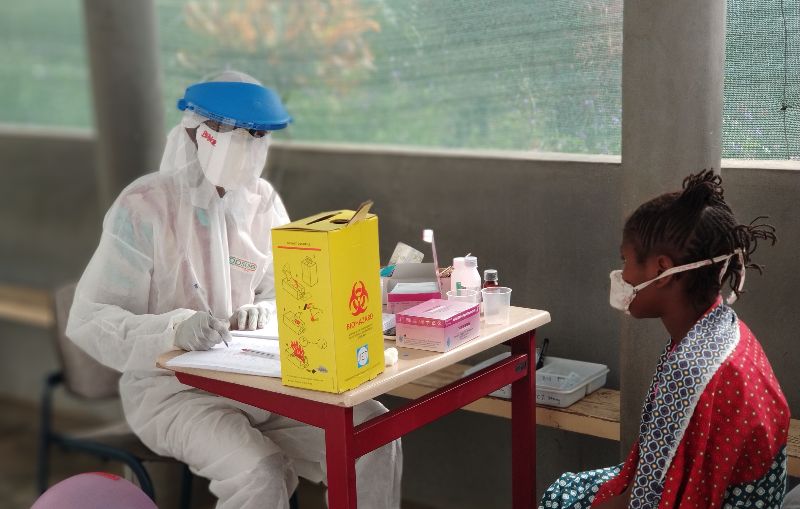
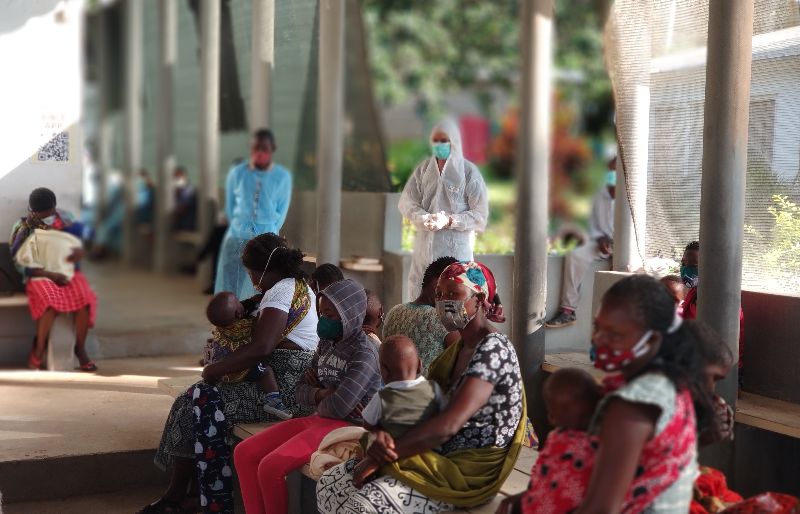
The past few months have brought about many changes to the way we practice on a daily basis. Patients are educated every morning about COVID-19 including measures to prevent transmission of the virus. They are required to wash their hands with soap on arrival, wear masks and maintain a 1-2 metre distance from others at all times. There is also a designated person who identifies patients with flu-like symptoms on arrival. These patients are placed in a separate waiting area and seen first so they can leave the premises as soon as possible. Staff are supplied with personal protective equipment (PPE), including gowns, masks and gloves and have access to hand sanitiser. Eye shields are worn during higher risk exposures such as consultations involving patients with flu-like symptoms. Gowns and masks are sterilised daily so they can be reused in order to sustain our PPE supply.
COVID-19 has been looming up in the background for several months and it is likely that we will be surrounded by it shortly. This does not change the daily struggle we face with malaria. We treat many cases of malaria every day and a large proportion of these patients are not well. Some present as life-threatening emergencies, particularly young children. Treatment for malaria is in short-supply and our main supplier of medication is unable to provide us with the number of treatments we need. We have therefore had to source treatment privately. There was recently a day where I went to work knowing we did not have malaria treatment to give. As patients tested positive for the disease we placed them aside and asked them to wait whilst we tried to find a way we could help these people. It was wonderful to see how God made a way and every patient that day went home with the treatment they needed. The struggle for enough malaria treatment continues but I marvel to think that to this very day God has always provided us with what we need. This is not only the case for malaria treatment, but also in many other aspects of the clinic. I am reminded of the verse in Hebrews 11 “But without faith it is impossible to please Him”. We all face daily trials, and perhaps even more so due to COVID-19, but my prayer is that these trials will increase and perfect our faith.
Article of Mid June / July 2020
Mr Mario Rocha, educating patients regarding COVID-19
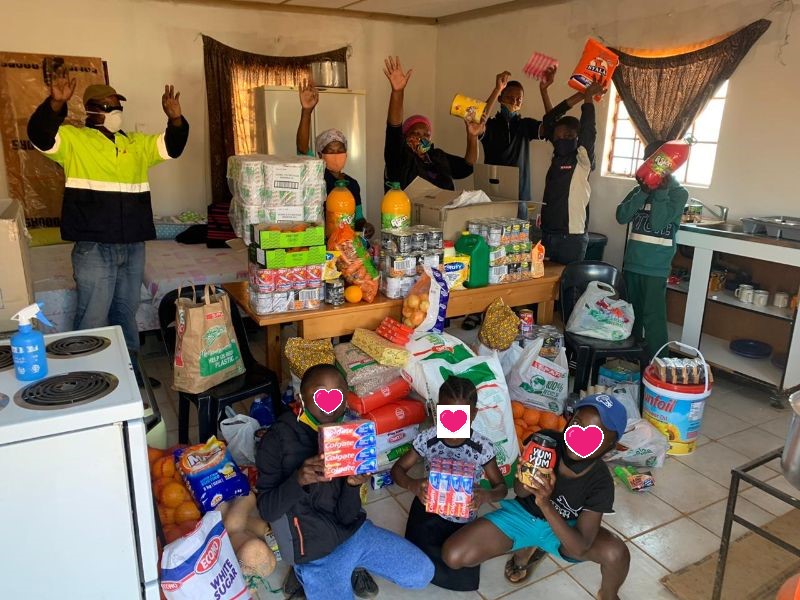
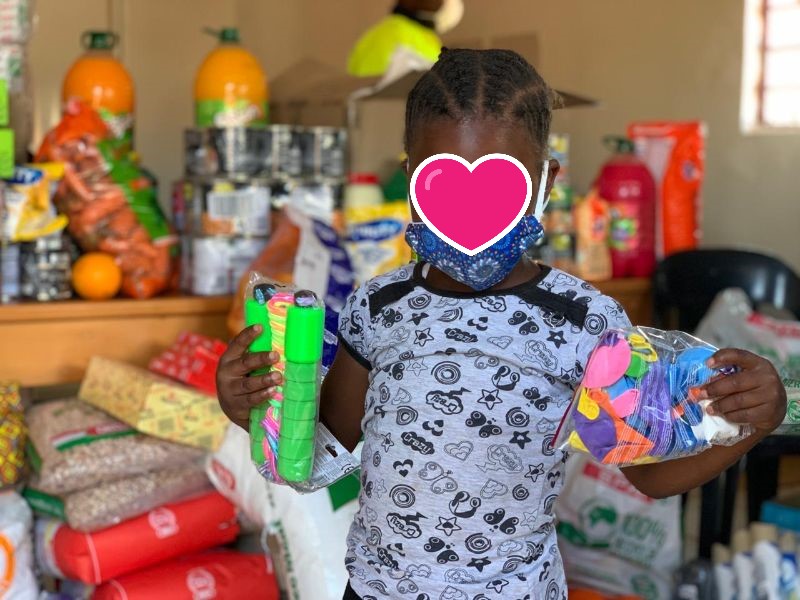
Food Delivery and Covid-19 training During a weekend in March, we visited four of our orphan centres in rural KZN. We delivered food parcels, clothing, and personal protective equipment like masks, sanitizers, and posters. Our team trained and informed our caregivers and children on how to stay safe during the Covid-19 pandemic and how the virus spreads. We taught them how important it is to wash hands regularly if someone showed possible symptoms of being sick with Covid-19 they were given the contact details of the person who would guide them on what to do next.
New developments Our garden project at Emthaleni is doing well, especially our mealies and fruit trees. We also had our entrance gate replaced with a stronger frame and material. Burglar guards were put up on the windows of the centre and our next goal is to get a new fence up around the property which has been graciously sponsored by Tear Fund. Currently, our Table Mountain centre only feeds the children and our long term goal is to turn the centre into a stay in the centre for the children. Recently we put up a ceiling and we were able to tile the floors. Another important goal was to put up security gates, we are grateful to have been able to accomplish that.
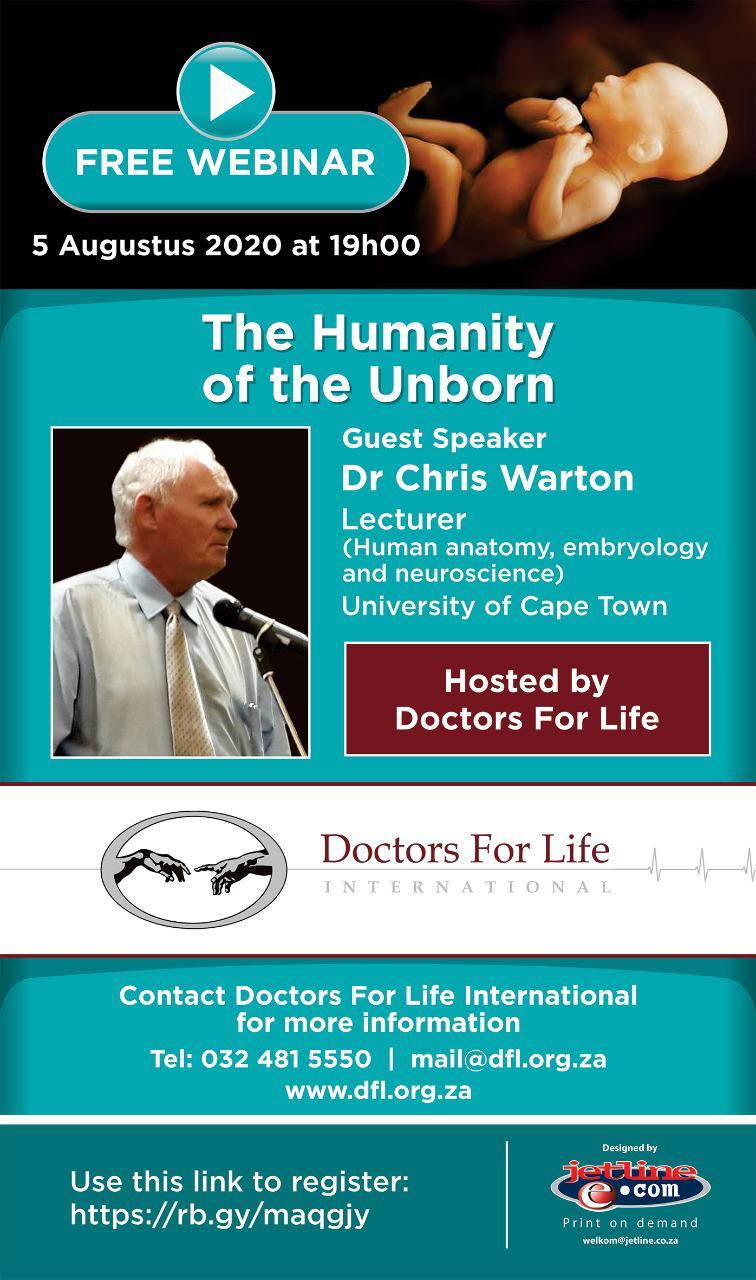
Doctors For Life International’s (DFL) webinar on “The Humanity of the Unborn Child” 5 August 2020. The guest speaker who did the presentation was, Dr Chris Warton, a Lecturer at the University of Cape Town on Human Anatomy, Embryology and neuroscience. Also included is Dr Albu van Eeden, CEO of DFL, and Mr Martus de Wet, from De Wet Wepener Inc. Attorneys.
For those who missed out and would like to have participated:
On 2 July 2020 around 19h00, Doctors For Life hosted a webinar on the topic of Abortion, Conscientious Objection and the Law. Our Guest Speaker was Adv. Keith Matthee SC and participants from across Africa, and from other countries joined us for this meeting.
The webinar also gave participants a chance to engage the speaker and put forward any questions they might have. For those who missed it and would like to watch the webinar, we have made this possible along with access to the power point presentation presented in the webinar.
As for the pro forma document mentioned in the webinar to the hospitals, contact [email protected] to get access.
This is written by Kimberly King, an award-winning author, teacher, and authority on the subject of sexual abuse prevention.
As parents, we all want to keep our kids safe from harm. We teach our kids to wash their hands, cover their mouths, buckle up the seat belts, and always wear a helmet when riding a bike.
Sexual abuse prevention is a bit more complicated than that.
The good news is that with investing a minimal amount of time in sexual abuse prevention education, parents and kids can be empowered. Learning about sexual abuse prevention can help parents protect their kids immediately.
Abusers have specialized methods to choose and manipulate victims through a variety of techniques and tricks. They try to gain the trust of the child and family first and eventually move toward “grooming.”
Learning about the tactics and tricks child predators use will help parents be more aware. Here are some red flag phrases and tactics abusers may use.
1. “Can you keep a secret?”
Secrecy.
Sexual abuse thrives under layers of secrets. If your child hears this phrase from an adult, it is a HUGE red flag.
A skilled abuser may first ask a child to keep a secret that seems innocent, saying things like
“Let’s keep this treat our little secret.”
“Don’t tell your mom we got ice cream before dinner.”
These are small, benign secrets that seem harmless.
When confident the child has kept those types of secrets the abuser will move on to acts of sexual abuse, demanding secrecy about that behavior as well. At that point, the child may feel so guilty and ashamed that he or she feels they cannot tell.
What you can do:
Tell young children that they must never keep secrets from their parents.
2. “You’re my special friend.”
Friendship.
Abusers try to build up relationships with kids by promoting common interests. They also try to establish trust with kids by attempting to make children feel special or unique. An abuser will try to gain the affection of his or her intended victim by sharing these likes and things they have in common.
What you can do:
A good rule of thumb to remember is that kids need age-appropriate friends, and adults need adult friends.
3. “Let’s spend some quality alone time together.”
Isolation.
A big red flag! Adults have adult friends, not “special” kid friends. Any activity that requires an adult to be alone with a child is not safe, especially overnights. Abusers try to normalize certain behaviors and lower inhibitions. So, a situation where a child must change clothing or do a sleepover is inherently risky.
What you can do:
Implement the rule of three. This rule requires that there should always be at least three people present – one adult and two or more children, or two adults and one child.
4. “Does Somebody need a hug?”
Affection.
Pats on the back, a hug to say goodbye– may be completely acceptable in many circumstances. Because of this, many predators seek careers where they have easy access to children. Be aware of your child’s reactions to other adults and comfort levels regarding physical affection.
What you can do:
Teach your children that if they ever feel uncomfortable about any physical contact, they need to tell you. Learn about consent and teach body autonomy to your little ones from an early age.
5. “Want to hear a dirty joke?”
Humor.
An abuser can lure a child closer by using jokes and games. These may start “G” rated. But, soon lead to “dirty” jokes, showing children online pornography, or by introducing sexual games.
What you can do:
If your child is old enough to have internet access, make sure you are monitoring email and social network messages. A predator may send explicit materials through social media apps. And may ask or demand inappropriate photos from your child. Kids can get easily trapped and scared in this predicament.
Consider installing Apps like BARK to protect and monitor your child.
6. “Your parents don’t understand you. I know how you feel.”
Empathy.
Sometimes, kids can feel isolated or alone, especially during family duress. Separations, divorce, or other changes in family structure or location can make kids more vulnerable.
Predators often target kids who feel isolated from their peers by using empathy.
What you can do:
If your family does go through a stressful period, pay attention. A great family counselor can help get ahead of some of these issues.
7. “Your parents will never forgive you if they find out what we did, you didn’t say No!“
Shame.
A child is not able to give consent in a sexual relationship. The blame/ shame, control game is hard to handle. The predator will use a child’s confusion and fear as they attempt to maintain control over the victim.
What you can do:
Kids need to know that no matter how long any inappropriate contact or abuse has gone on, it is NEVER their fault, and you will always help, protect, and love them.
A prepared child is less of a target.
Parents have the immense responsibility of trying to protect their families from sexual abuse. The best way to add a layer of protection is to educate yourself and your kids about sexual abuse.
Sexual abuse can be prevented when parents learn the facts about sexual abuse and minimize the risks for the family.
Some parts of the website make use of cookies for optimization.
Functional
Always active
The technical storage or access is strictly necessary for the legitimate purpose of enabling the use of a specific service explicitly requested by the subscriber or user, or for the sole purpose of carrying out the transmission of a communication over an electronic communications network.
Preferences
The technical storage or access is necessary for the legitimate purpose of storing preferences that are not requested by the subscriber or user.
Statistics
The technical storage or access that is used exclusively for statistical purposes.The technical storage or access that is used exclusively for anonymous statistical purposes. Without a subpoena, voluntary compliance on the part of your Internet Service Provider, or additional records from a third party, information stored or retrieved for this purpose alone cannot usually be used to identify you.
Other
The technical storage or access is required to create user profiles to send advertising, or to track the user on a website or across several websites for similar marketing purposes.